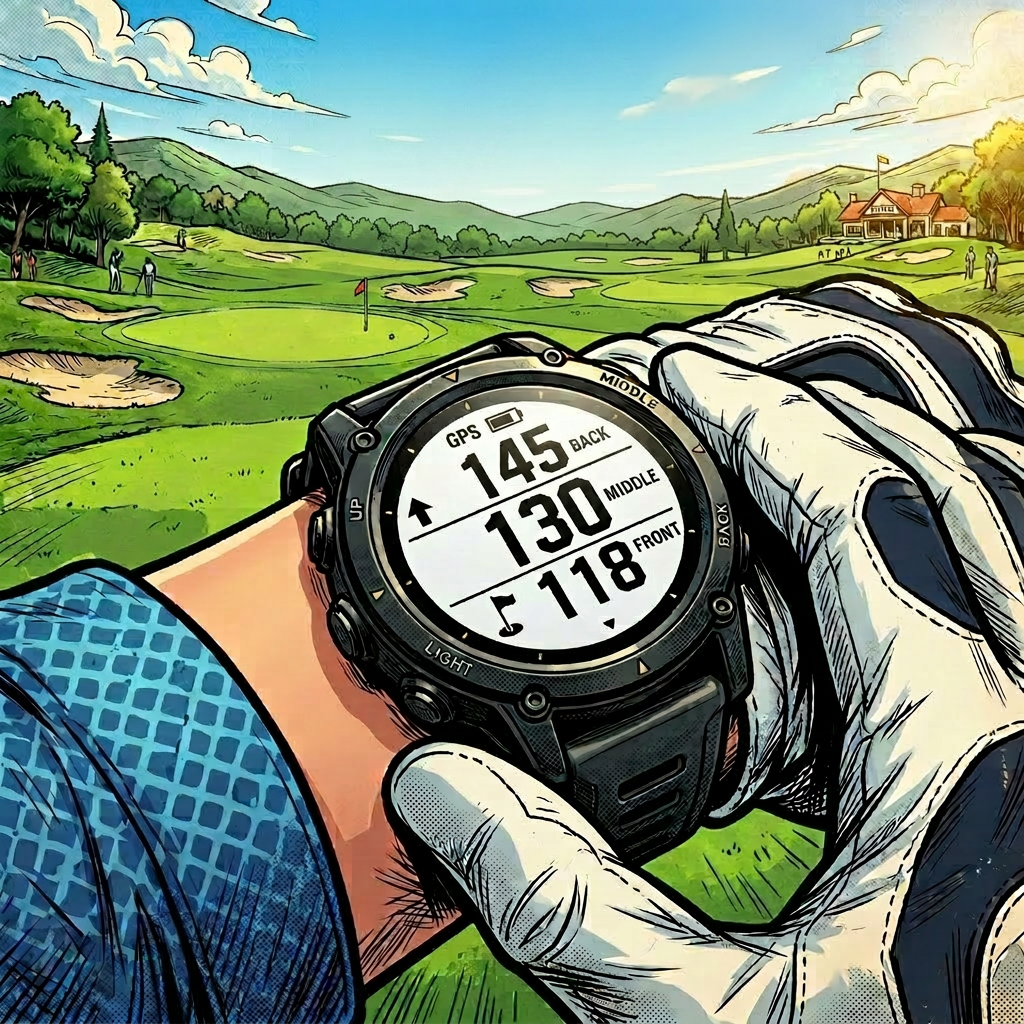
Summer in Seattle is pretty great. I try to take advantage of the long days, assuming the weather and my knees cooperate, to get out on the golf course. I’m at best an average golfer with a world class passion for the game.
On a recent round at my local public course, I saw a pretty familiar sight that made me just shake my head. A player from the group behind us had hit their drive into our fairway, over a tree line. They realistically had zero shot at the green from there. It would have been almost impossible to even see the green through all the trees, yet they stopped everything to pull out a rangefinder to attempt to read an exact distance to the pin.
You know what happened next. Whatever miracle PGA Tour pro shot they have visualized turned into a topped ball bouncing along the tree line, a slammed club, some profanity, and another rescue shot. Of course after yet another precise measurement from their trusty rangefinder.
I don’t use a rangefinder. Lots of friends do and swear by them, but honestly I think they are one of the things that have slowed golf to a crawl in recent years. They came with the promise of faster play since golfers would know their distances more accurately. Instead we got a generation of wannabe Tigers who have gone pin-hunting.
The PGA Tour actually started allowing rangefinders this year hoping they’d speed up play. Tour caddies were skeptical from the start — one said flatly they’re “100% going to slow play down.” Watch that guy behind you on the 5th hole at West Seattle GC and you’ll already know who’s right.
Instead I wear a watch. The Garmin Instinct Crossover on my wrist gives me three numbers every time I walk up to a shot. Front. Middle. Back. Yardages to the green, all of them — not to the flag, not to the stick, not to that little piece of fabric that most hackers spend an inordinate amount of time trying to laser precisely.
Those three numbers are changing the way I play golf for the better.
I get the rangefinder appeal. There’s something satisfying about that little beep and the instant readout — 147 to the pin, exactly. Precision. You feel like a pro. It’s like a caddie in your pocket. Except it isn’t. You know what the caddie is telling the tour pro? Yardages to the front and back, then the pin in relation to that. The focus is on execution, not on false confidence in a number.
Average golfers aren’t pros. And the pin is not the target.
what the watch is actually telling you
Using a golf GPS — watch, app, speaker, whatever — pulls front, middle, and back yardages automatically. No pointing. No clicking. I like having a watch because there’s no holding it steady while I wait for it to lock onto a flag 160 yards away. I glance at my wrist. I have three numbers. I move on.
What those three numbers give me is something a rangefinder can’t: a mental picture of the green. Front is 135. Middle is 148. Back is 162. That’s 27 yards of depth — 81 feet — of green I’m trying to find. That’s a big target. That’s a friendly target. That’s the kind of target that should make an average golfer feel like they have options. Instead of playing for the 1 in 10 optimal outcome, because remember I’m not a tour pro, I can play for the average outcome and at least get it on the green where my putting saves me more strokes.
A rangefinder collapses all of that into a single number — 142 to the flag — and in doing so, it implicitly tells you that the flag is where you’re supposed to be going. Which is exactly backwards for someone carrying a 19-handicap.
the seduction of precision
I understand why rangefinders are popular. Holding a device that reads one forty-seven with a beep feels like competence. It feels like information. We’re trained in business that more information, more data, more precision is always good. It’s not. It’s often just noise.
Precision is only useful if you’re solving the right problem. The pros are solving for proximity-to-the-pin because they can actually control where the ball lands on a green. Their shot dispersion from 150 yards is genuinely measured in feet. Mine, and likely yours, is measured in something considerably larger.
I’m not hitting it stiff. I’m trying to get it somewhere on the putting surface and two-putt. That is a fundamentally different problem, and it requires a fundamentally different target.
three numbers, better decisions
What front-middle-back yardages do is force a mental shift that’s actually useful. Instead of asking “how do I get it to 142?” I’m asking “what club gets me reliably somewhere between 135 and 162?” Those are not the same question, and the second one is considerably more honest about what I’m actually capable of.
It also changes where I aim. When the pin is front-left, I used to aim at the pin. Now I might use the yardage for the back of the green (in case I mishit and come up short) and aim at the center of the green (to give myself more margin if I fade or hook the shot). That’s not a small tactical shift; for an average golfer, it’s the difference between bogey and double.
A piece over at MyGolfSpy that got me thinking about this argues that a rangefinder gives you precision while GPS gives you context. I’d go further. For the average golfer, the precision a rangefinder offers is precision for the wrong target. It’s like using a caliper to measure something that only needs a ruler — and then making decisions based on the extra decimal places as though they actually mattered.
The green can be roughly 6,000 square feet. The pin is about two inches wide. One of those is a realistic target for most golfers. You don’t need to spend $300 on a rangefinder to figure out which one. You definitely don’t need to slow down your round taking measurements all the time trying to figure out the yardages just to hit it into the trees.
A GPS watch, a speaker on the cart, a yardage app on your phone — any of them will give you front, middle, and back. Any of them will help you see the green as the target instead of the flag.
The pin will still be there when you get to the green. That’s what putting is for.
