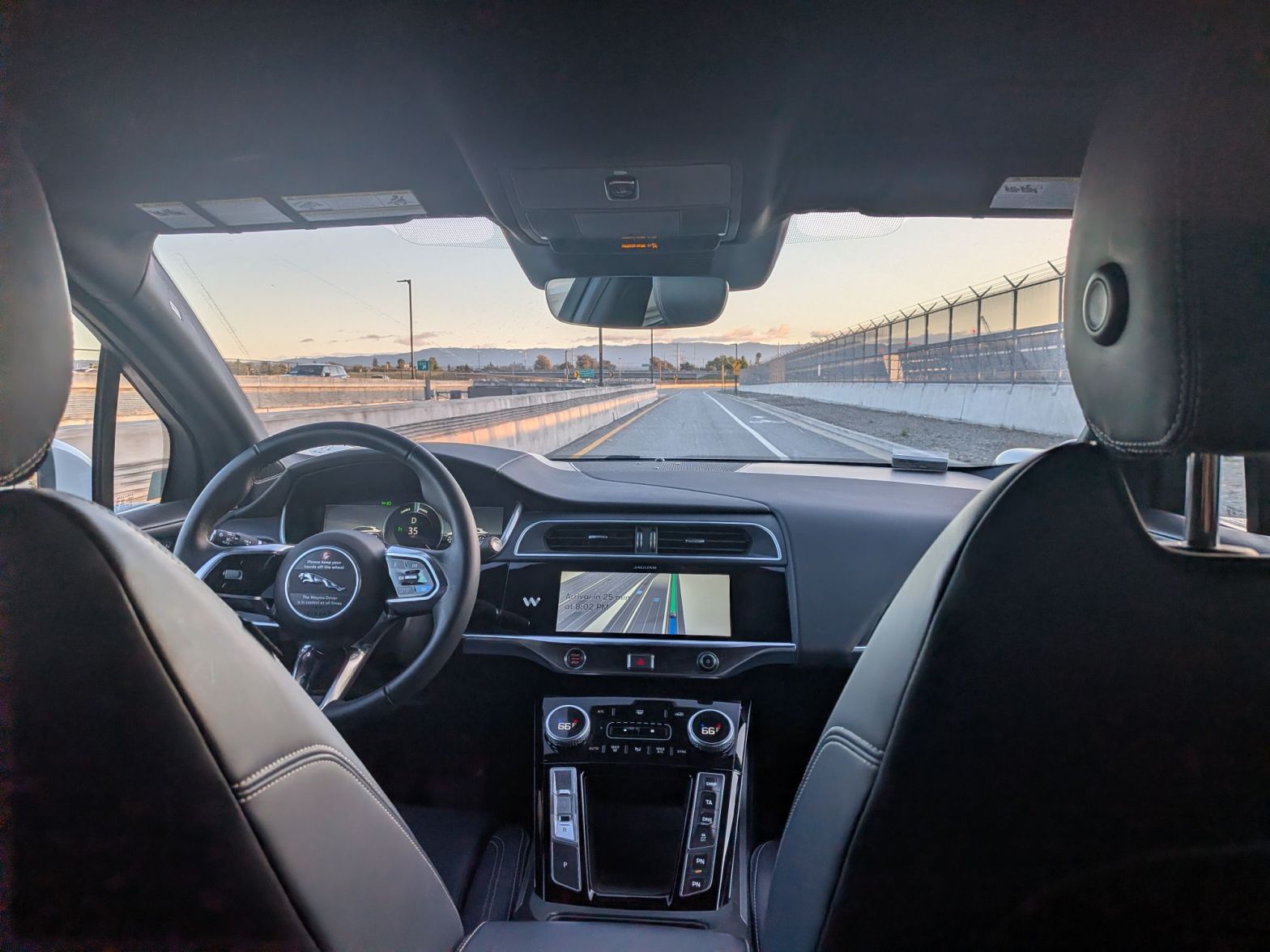
Sunday night, San Jose airport, I’m in the rear passenger seat watching a Jaguar I-PACE ease into traffic without a human behind the wheel — and then do a right on red. Fluidly. Correctly. It just… did it.
It’s just a post-COVID reality for me that I don’t travel as much. Living in Seattle I don’t visit cities with AV services or have the opportunity to take advantage of them, despite wanting to. I’d been meaning to try Waymo in particular for a while, and they’ve been running in the Bay Area long enough that I’d long ago stopped thinking of the service as novel despite their well-documented issues. But watching the car read the intersection, check for pedestrians, and roll through that turn the same way any experienced driver would — I just started laughing.
That’s the coolest thing I’ve ever seen in a car.
The trough is over
There’s a line from Gartner’s technology hype cycle — the “trough of disillusionment” — that perfectly describes what happened to autonomous vehicles after 2019. Intel, Uber, General Motors, and others had made enormous bets that robot cars were imminent. Those bets largely ended in tears. In 2017, Uber announced a deal to buy 24,000 Volvos to convert into autonomous vehicles by 2019. It never happened. One of Uber’s test vehicles struck and killed a woman outside Phoenix in 2018. The company eventually abandoned its in-house AV efforts entirely. The swagger evaporated.
I was running ReachNow, BMW’s car-sharing service in Seattle, right through that period. Mobility services were built on the idea that costs would drop when cars could reposition themselves instead of relying on human intervention, and BMW had its own AV testing projects. I’d hoped ReachNow would be a beachhead to test AVs in Seattle, and we hosted teams from Munich to understand how US consumers used car and ride sharing services. But the regulatory moment wasn’t there, the infrastructure wasn’t there, and increasingly it was clear the technology wasn’t quite ready either. The dream slid into the trough.
Something has shifted. Tim Higgins wrote in the WSJ this March that it’s “feeling like 2016 all over again” — with a key difference: this time there’s real commercial deployment behind the hype, not just promises. Alphabet has now tied CEO Sundar Pichai’s comp, for the first time, directly to Waymo’s valuation — up to $260 million in shares if it keeps climbing. Uber is signing AV partnerships with Zoox, Motional, and Rivian (10,000 dedicated robotaxis, beginning 2028). Travis Kalanick — the man who bet Uber’s future on self-driving and lost — has quietly been the biggest investor in Anthony Levandowski’s latest AV startup and is now folding it into a new venture. These are not the moves of people who think this is another bubble.
And then there’s this, from TechCrunch:
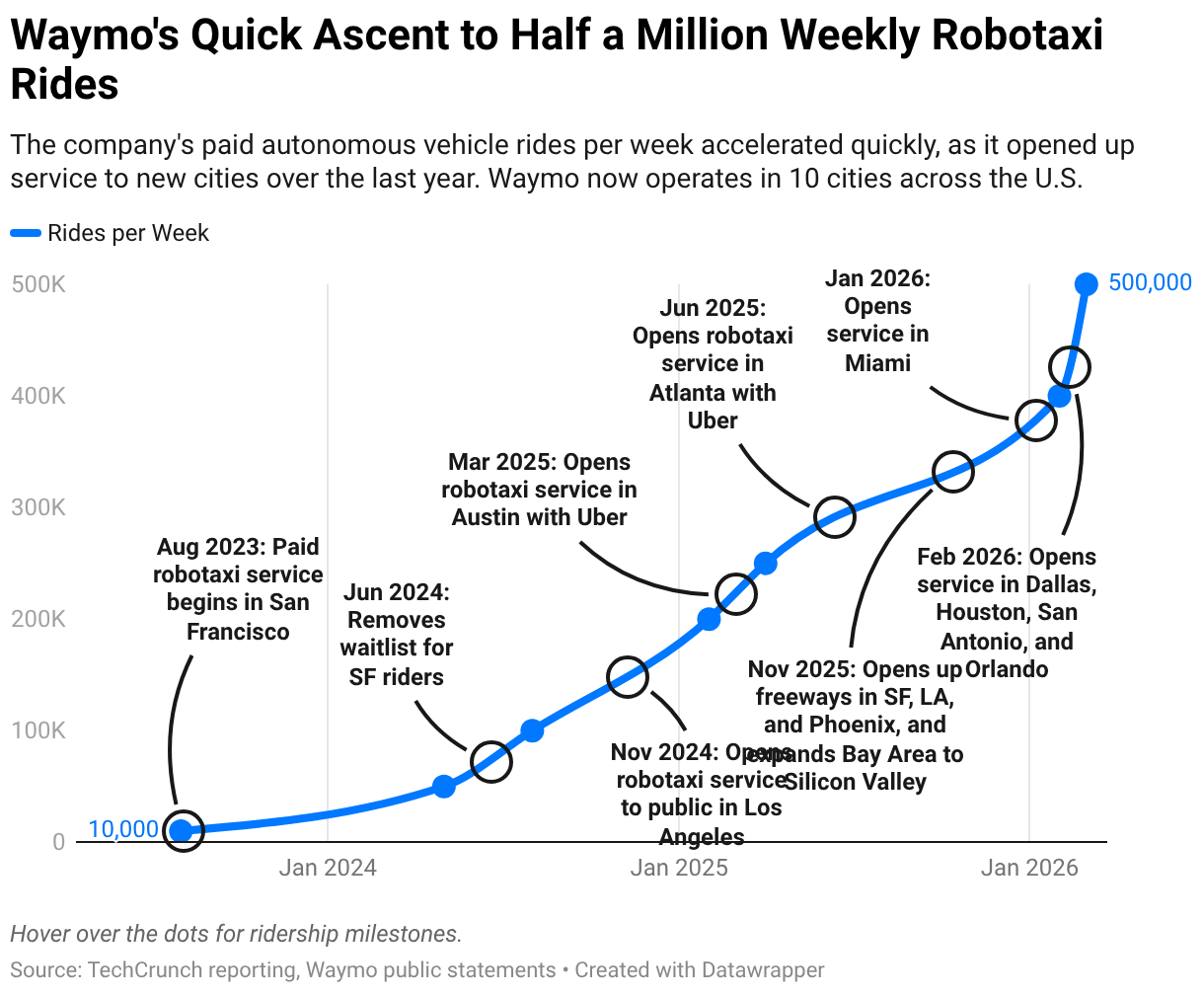
Waymo’s weekly paid rides: 50,000 in May 2024 → 500,000 by early 2026. Tenfold in under two years.
(Chart: Waymo’s skyrocketing ridership in one chart, TechCrunch)
Waymo vehicles now get name-checked in Conan O’Brien’s Academy Awards monologue. You don’t make the Oscars monologue as a curiosity. You make it when you’ve become furniture.
What the car actually does
The hard part of autonomous driving isn’t the obvious stuff. Any car can drive in a straight line or park itself in a tight space. The hard part is the edge — a guy walking his dog across the middle of a block at dusk, threading between parked cars, nowhere near a crosswalk (the Waymo eased to a stop and waited, the way a very considerate human driver would, then continued when they were clear), the driver ahead who doesn’t go on green (the Waymo waited, patiently, without honking), the navigation question of whether the back road beats the freeway on a Sunday night (it probably did). The car makes a thousand quiet judgment calls you never notice, because they’re all correct, even if a little tentative.
That right-on-red move is what got me. Tracking oncoming traffic, checking the crosswalk, judging the gap — and just doing it, with the casual confidence of someone who’s driven that intersection a hundred times. I didn’t expect to be moved by a car making a legal turn. But I was.
I kept thinking: we would have killed for this at ReachNow. Different era. Different regulatory moment. Still.
The phone UI is precious
Here’s where I’ll be a little less generous, because Waymo deserves honest feedback: the smartphone experience needs work. Not the in-car experience — the head unit has big, sensible buttons, the kind you could operate while distracted, disoriented, or just tired from a flight. Those are fine.
The phone app is something else. It’s designed for people who already know what they’re doing. Small, cool buttons. Minimal labeling. The kind of UI that wins design awards and causes a first-time user to stand on the curb for five minutes trying to figure out how to unlock the car.
I didn’t expect to take a Waymo until I saw the signs at SJC. When I did, I thought I’d install the app and check, just in case, to see if coverage had extended into Mountain View where my hotel was. I got the app installed on my Google Pixel and signed up quickly. That was easy enough. Even putting in my destination and getting confirmation that yes, Waymo would pick me up and take me to Mountain View, was as straightforward as Lyft or Uber.
What wasn’t great was the wait. It took over 15 minutes for the car to arrive, but I was willing to tolerate that to try the service. However, figuring out from the outside which Waymo was mine out of the several that arrived was genuinely a little broken — one family kept trying to jump in every Jaguar that pulled up.
When the car did arrive, I was navigating an interface that felt, and I don’t mean this harshly, precious. Like the designer wanted credit for restraint. The trunk button should be three times the size, especially for an airport pickup. Context awareness would help enormously: if Waymo knows someone just landed at SJC with luggage, pop the trunk when you unlock the doors. Don’t make them hunt for the small icon. That’s just obvious.
The gap between the app working smoothly and the app being confusing is also the gap between Waymo working for everyone and working only for early adopters willing to puzzle through it. The car is smart enough to stop for a dog walker mid-block in the dark. The app shouldn’t require a tutorial.
Voice is the missing piece
The natural interface for getting from one place to another has always been talking. You told your driver where to go. You said actually, just drop me at the corner. You asked them to wait. It was conversational because you were collaborating with another person in real time.
AVs with real voice control would be something else entirely. Open the trunk. This is fine, let me out here. Can you pull forward a bit? These are natural, human instructions — the kind anyone can give, from a five-year-old to someone who’s never touched a smartphone. Every modern car already has decent voice recognition for navigation and music. The engineering isn’t the obstacle. The gap is making voice the primary control surface for the cabin, not a secondary feature buried behind the app. That’s a product decision, not an engineering problem.
When that happens, AVs stop being a tech product for early adopters and start being what they’re supposed to be: infrastructure. Something anyone can use, anywhere, in the dark, without installing anything or finding the small cool button.
Uber’s president for autonomous mobility told the WSJ: “Seeing is believing.” I already had faith in the promise of AVs, but my Sunday night ride from SJC made me a believer in their reality. When you can just say Waymo, let me out here with the same ease you’d say it to a person, that’s when the technology finally catches up to the promise.
Discover more from stevebanfield.blog
Subscribe to get the latest posts sent to your email.
